

BS 8214:2026: Can I Still Use Expanding Fire Door Foam?
Fake News: Dispelling the Myths Around BS8214 and Fire Sealing Foams
Short answer: yes, you can still use expanding foam on fire doors under BS 8214:2026. The standard hasn't banned foam, restricted it to niche use cases, or quietly phased it out - despite what you may have heard on site or read into a misquoted clause. What it has done is tighten the requirement for proof: any foam or mastic used as a fire stop needs relevant, product-specific test evidence behind it. Products like Blue60, tested extensively across doorset types, frame materials and gap widths, meet that bar easily. Below, we separate the genuine changes in BS 8214:2026 from the myths that have sprung up around it.
BS 8214:2026, the fire door frame sealing standard covering specification, installation and maintenance in the UK, is not complicated, and it certainly doesn't require a degree in rocket science to understand. Published by the British Standards Institution (view the official BS 8214:2026 product page) on 20 March 2026, the revised code of practice replaces and withdraws BS 8214:2016, and addresses several anomalies and grey areas that had crept into industry interpretation over the previous decade. The result should be greater clarity, safer installations and more confident specification, but as with any major revision, it has also produced a wave of confusion, much of it born from previous editions being misquoted or clauses being taken out of context.
BS 8214 is a code of practice intended for the full range of professionals and organisations involved in the provision, specification, installation, inspection and maintenance of fire doors, from manufacturers and main contractors through to building safety managers and inspectors. Since the 2026 edition's release, we've noticed a worrying trend: installers and specifiers second-guessing well-established, tested fire sealing products, often based on misinformation rather than the standard itself.
So let's dispel the myths. Below, our Technical Manager Andy Walsh answers the questions we're hearing most.
What's actually changed in BS 8214:2026?
Before tackling the myths, it's worth understanding what's genuinely new. BS 8214:2026 makes several substantive changes compared with the 2016 edition:
- Scope has widened significantly. The 2016 edition focused on timber-based fire door assemblies. The 2026 edition covers fire door assemblies of all materials (timber, steel, aluminium and composite) with dedicated annexes for material-specific guidance.
- Installation requirements have been clarified, particularly around the areas that previously caused confusion (formerly addressed in section 9.4), to reduce the risk of misinterpretation and non-compliant installations on site.
- Smoke control guidance has been updated to align with the latest revisions to BS 9991, including best practice around under-door gaps.
- The overall emphasis has shifted toward evidence. Rather than a single fixed rule for every scenario, the 2026 edition places greater weight on the test evidence, manufacturer's instructions or competent assessment that supports a given installation detail.
That last point matters more than it might first appear: it's the thread running through almost every myth below.
The revision also lands against a wider regulatory backdrop. Duty holders under the Building Safety Act 2022, along with those managing obligations under the Regulatory Reform (Fire Safety) Order 2005, are increasingly expected to demonstrate, not just assert, that fire door sealing arrangements are fit for purpose. BS 8214:2026 gives that requirement a clearer framework to work within, which is exactly why getting expanding foam fire door compliance right, rather than relying on generic assumptions, matters more now than it did under the 2016 edition.
Myth 1: "You can't use Blue60 as a gap-filling fire stop between the door frame and supporting construction"
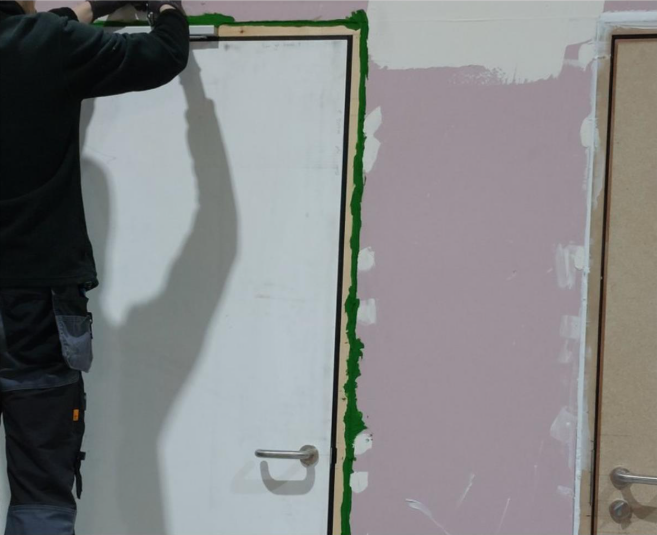
Fact: BS 8214:2026 does not place a blanket restriction on the use of expanding foams or mastics between the door frame and supporting construction. What it does require, and this is where the myth usually takes root, is that whatever product is used must be backed by appropriate, relevant fire test evidence for that specific application.
This is not a loophole; it's the whole point of the standard's evidence-led approach. A generic, untested foam grabbed off a builder's merchant shelf is not what BS 8214:2026 has in mind. A system like Blue60, tested extensively across single and double timber doorsets and multiple frame-and-wall combinations, is. The standard isn't softening its stance on fire stopping; if anything, the 2026 edition sharpens the requirement for traceable, product-specific evidence. Blue60 clears that bar comfortably; unproven alternatives don't.
Myth 2: "Fire door foam always needs standalone BS EN 1366-4 testing"
Fact: No. This is probably the most persistent piece of misinformation circulating since the 2026 edition landed, and it deserves the clearest possible answer.
BS 8214 recognises two separate, equally valid routes to demonstrating compliance for a linear gap seal: the BS EN 1634-1 vs BS EN 1366-4 question that generates the most queries to our technical team.
| Route | Standard | What it tests |
|---|---|---|
| 1. Standalone linear joint seal | BS 476-20 or BS EN 1366-4 | The product's ability to maintain the integrity of a linear gap under fire conditions, including the rapid temperature rise associated with flashover |
| 2. Complete fire door assembly | BS 476-22 or BS EN 1634-1 | The sealing system as a genuine component of the tested doorset (frame, foam, packers and all) |
A linear joint seal test under BS EN 1366-4 is not a mandatory prerequisite where a product already has primary fire test evidence generated specifically for fire doors. Blue60 falls squarely into route two: it has been tested in every practical combination of frame and wall material, across single and double doorsets, at both 30 and 60-minute ratings, to BS 476 Part 22 and BS EN 1634-1. That's a complete, end-use-relevant evidence base for fire-resistant pedestrian doorsets: not a substitute for compliance, but a direct demonstration of it.
The key takeaway for anyone specifying or inspecting: ask for the fire test report and check that it covers the system as installed. Whether that evidence comes via the linear-seal route or the full-assembly route, both are legitimate under BS 8214:2026, provided the product and configuration in the report actually match what's on site.
Myth 3: "You can't use expanding foam on composite or plastic door frames"
Fact: You can. Blue60 has been tested and approved for use across several types of construction, including composite ("plastic") door frame systems, not just traditional timber.
That said, composite and engineered frame materials behave differently to timber in a fire, and installation detailing can vary between systems houses. Our recommendation, and BS 8214:2026 itself points installers in this direction, is to review the relevant Systems House Installation Guidance before using any fire sealing product with a composite or non-standard frame system. This isn't extra bureaucracy; it's the same evidence-led principle running through the whole standard: match the product's tested configuration to the real-world application before you start foaming.
Why test evidence matters for BS 8214:2026 compliance
If there's one lesson to take from BS 8214:2026, it's this: the standard has moved away from prescribing a single tolerance or method for every situation, and toward requiring specifiers, installers and inspectors to be able to demonstrate why a given detail is compliant. That puts the burden of proof on evidence, not assumption.
This is exactly why Blue60 has been tested on over 100 fire tests, holds NHBC acceptance, and is backed by an IFC Global Engineering Assessment Report. It's also why our foam is coloured blue, a small but deliberate detail that makes it instantly identifiable on site and easy to distinguish from other, less rigorously tested products during inspection. When a fire door inspector or building control officer asks "how do you know this seal performs?", the answer needs to be a test report, not a sales sheet.
Getting linear gap seal compliance right: practical takeaways
- Use a sealing system tested as part of a full doorset assembly (BS 476-22 or BS EN 1634-1), or one independently tested as a linear joint seal (BS 476-20 or BS EN 1366-4); both routes are valid under BS 8214:2026.
- Check the product's tested gap width range before installation, and don't exceed it. Blue60, for example, is tested for gaps from 3mm up to 39mm.
- Don't add capping mastic unless the tested system specifically calls for it. For Blue60, no additional sealant is required to achieve up to 60 minutes of fire protection.
- Always check the relevant Systems House Installation Guidance when working with composite, aluminium or steel frame systems.
- Keep photographic and documentary evidence of the linear seal for Regulation 38 handover packs. Non-intrusive fire door inspections rely heavily on this record, and intrusive checks (removing architraves) should only be carried out by a suitably qualified, insured contractor.
- Where smoke control is also required (FD30S / FD60S doors), confirm the sealing system's cold smoke performance alongside its fire rating; this sits alongside, not instead of, the fire test evidence above.
The bottom line
BS 8214:2026 hasn't made fire door sealing more restrictive for the sake of it. It's made the requirement for proof more explicit. Products with genuine, relevant test evidence, like Blue60, aren't caught out by the revision; they're exactly what it's designed to reward. The confusion in the market isn't coming from the standard itself, but from previous editions being misquoted and clauses read in isolation.
Blue60 remains committed to continuous testing and the future-proofing of our systems in line with current regulatory requirements. Our technical support team is on hand to help you navigate testing and certification questions, whatever the frame material or gap configuration.
In Short - Yes, expanding fire door foam can still be used after BS8214:2026.
Need clarity on a specific installation? Get in touch with our technical support team to talk it through.
Frequently Asked Questions
Can I still use Blue60 after BS8214:2026? Yes. BS 8214:2026 does not restrict the use of expanding foams or mastics between the door frame and supporting construction, provided the product is supported by relevant fire test evidence for that specific application.
What test evidence is needed for compliance with BS 8214:2026? Fire test evidence can be to BS 476-22 or BS EN 1634-1, provided the fire test report covers the system being used and confirms it achieves the required performance class for the period of fire resistance specified.
Does fire door foam need to be tested to BS EN 1366-4 (Linear Gap Seals)? Not necessarily. Where primary fire test evidence already exists for the product as part of a complete fire door assembly (BS 476-22 or BS EN 1634-1), a separate linear joint seal test to BS EN 1366-4 is not required to demonstrate effective fire sealing in end-use applications such as fire-resistant pedestrian doorsets.
Can Blue60 be used for sealing composite ("plastic") door frames? Yes. Blue60 has been tested and approved for use in composite frame constructions. Installers should review the relevant Systems House Installation Guidance before use, as referenced in BS 8214:2026's code of practice.
Subscribe by email
You May Also Like
These Related Stories

From BS 476 To BS EN1634: What Specifiers Need To Know
How To Eliminate Risks When Specifying Fire Door Products
No Comments Yet
Let us know what you think